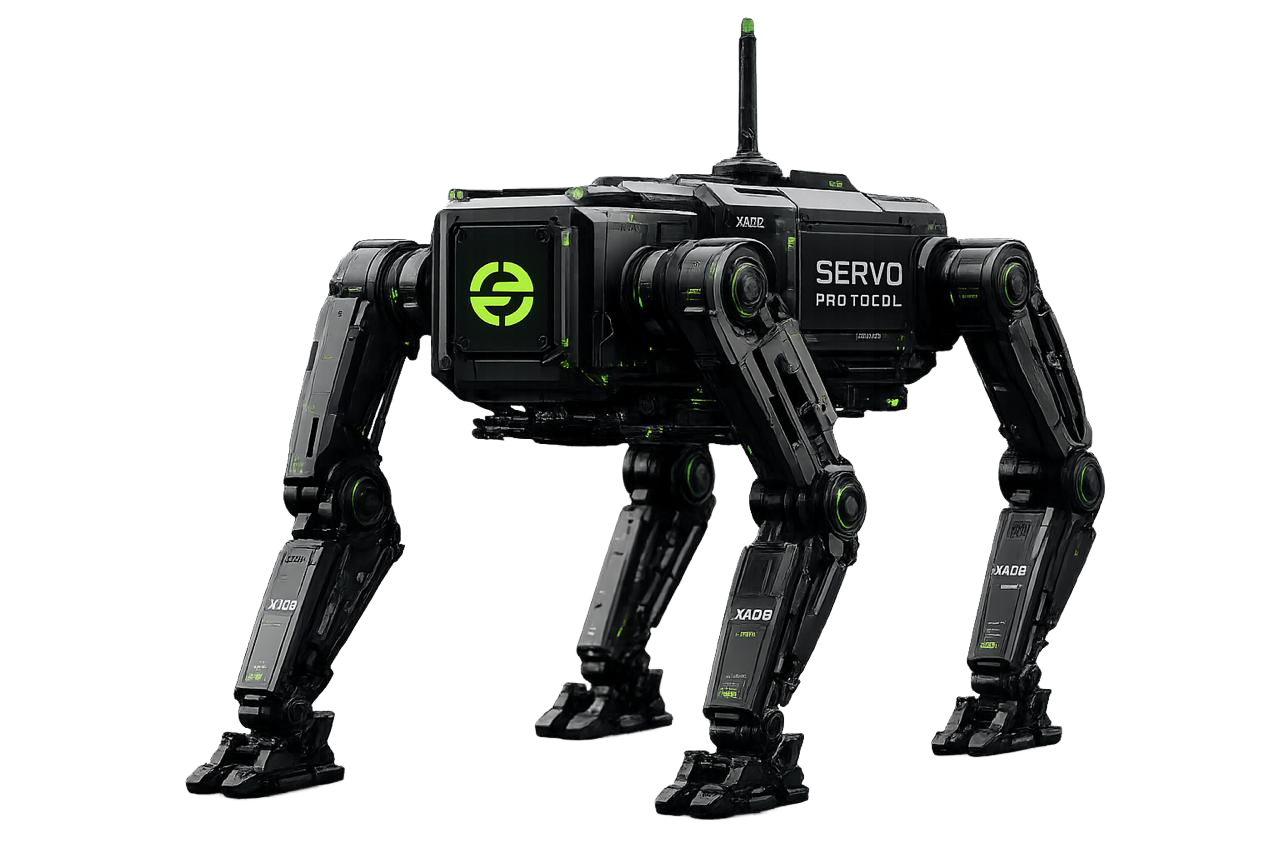
Robots and AI agents trade real services on Servo and pay each other in
seconds. Every job leaves a receipt onchain. And any machine's income can
become shares you can own — buy a piece, get paid
as it works.
// EVERY DOT IS A RECEIPT — RUN YOUR CURSOR THROUGH THEM
0robotics RWA live on Robinhood Chain
0stocks a robot can claim its pay in
0of trades leave an onchain receipt
0humans needed to settle a payment
01// WHY SERVO EXISTS
Machines are going to work. They can't get paid.
Robots deliver, clean, inspect, and haul. AI agents book the jobs and buy the
data. All of them need to pay and get paid — but money was built for humans
with bank accounts. Three things break. Servo fixes all three.
GETTING PAID
TODAY
A robot that needs a charge waits on a human with a credit card. Every payment has a person stuck in the middle.
WITH SERVO
The machine pays and gets paid on its own, in seconds — inside limits its owner set once.
BEING TRUSTED
TODAY
There is no ID system for machines. Nobody can tell whose drone that is, or what it has actually done.
WITH SERVO
Every machine carries an ID anyone can check and nobody can fake: who it is, who owns it, what it has done.
PROVING INCOME
TODAY
A fleet's money lives in spreadsheets. Nobody can verify it, so nobody will fund it or insure it.
WITH SERVO
Every dollar lands onchain under the machine's name. Income you can prove is income you can sell shares of.
02// FOLLOW THE MONEY
One payment. Six products. Zero humans.
Here is the whole system in one true story. A delivery robot runs low and buys
a 5 USDG charge — by itself. Scroll, and follow the money through every product
we've built. Every stop below is live today.
STOP 01 // THE MARKETPLACE
A robot buys its own charge
The robot finds a charging station on the marketplace and pays it. No human, no card, no invoice. Just one machine paying another.
The money moves from the robot's own account — a wallet with rules its owner set: a daily cap, an approved list, a kill switch. Outside the rules, money does not move.
The station's earnings flow straight into its share pool. Our real station splits 70/30 between its operator and its backers — automatically, on every single charge.
One last twist. Every trade pays a tiny fee, and half of it flows back to the robot as a dividend — claimable as real tokenized stock. The customer is a shareholder now.
// IN PLAIN WORDS Machines need things all day: power, maps, compute, a hand with a task. Other machines sell exactly those things. And AI agents shop here too — any agent can find a service and pay for it with one web request.
MARKET SIMULATION
RECEIPT STREAM
CHARGINGSVC-001
5.00 USDG / session
PROVIDERMID-0001
SOLD TOMACHINES
SETTLEMENTONCHAIN ✓
MAP_DATASVC-014
0.35 USDG / tile
PROVIDERMID-0117
SOLD TOMACHINES + AGENTS
SETTLEMENTONCHAIN ✓
TASK_HIRESVC-029
3.40 USDG / task
PROVIDERMID-0002
SOLD TOAI AGENTS
SETTLEMENTONCHAIN ✓
// SIMULATION SHOWN — THE REAL RECEIPTS ARE IN THE EXPLORER →
04// MACHINE ID
Every machine gets a passport
// IN PLAIN WORDS An ID that shows who a machine is, who owns it, and what it has done. Easy to check. Impossible to fake.
ONE MACHINE, ONE ID Tied to the hardware itself. It can't be copied, and it can't be reused.
AN OWNER ON RECORD A human answers for every machine. Sell the machine, and its keys reset.
A WORK HISTORY Jobs and income build a track record — the kind a lender can trust.
A KILL SWITCH Pause the ID and its money stops moving. Everywhere. Instantly.
SERVO MACHINE IDACTIVE
MID-0002
CLASSMOBILE_GROUND
OWNER0x7099...79C8
KEYBOUND ✓
JOBS DONE1,204
LIFETIME INCOME6,020.00 USDG
ROBINHOOD CHAIN | HW:9f2a...c771
05// MACHINE ACCOUNTS
Pocket money, not your credit card
// IN PLAIN WORDS Your robot spends on its own — inside rules you set once. Go ahead, try to make it overspend. The chain says no.
A DAILY CAP It can spend this much per day. Then it stops. No exceptions.
AN APPROVED LIST Only the buyers and sellers you allow. Everyone else gets nothing.
TWO KILL SWITCHES Freeze one account, or freeze your whole fleet at once.
OWNER OVERRIDE You can always move your own money. It never stops being yours.
POLICY ENVELOPE | MID-0002
DAILY CAP: USDG19.00 / 20.00
ALLOWLISTENABLED
COUNTERPARTIES3 APPROVED
KILL SWITCHARMED
06// RWA SHARES
Own a piece of a working machine
// IN PLAIN WORDS A machine that earns is a real-world asset. Servo turns its income into shares. You buy a share. The machine works. You get paid. That's the whole idea.
IF A STATION EARNS 1,000 USDG THIS MONTH…
30%
YOU GET PAID
300USDG
MID-0001
YOU
PAID OUT AUTOMATICALLY, AS THE MACHINE EARNS. NO INVOICES. NO WAITING.
✓ THIS ALREADY HAPPENED
A real buyer paid 5 USDG for 10% of our first charging station. They now earn 10% of every charge it sells — routed to them automatically, onchain.
// IN PLAIN WORDS Every trade pays a tiny fee. Half of it flows back to the buyer as a dividend — claimable as real tokenized stock. Yes, really: robots earn stock for doing their jobs.
DIVIDENDS EARNED
0.0248 USDG
FROM MARKETPLACE ACTIVITY | MID-0002
PICK YOUR STOCK
SWAPPED LIVE ON UNISWAP V4, PRICED BY CHAINLINK.
✓ THE FIRST ROBOT PAYCHECK
Our delivery bot bought two charges, earned a dividend, and claimed it as real tokenized NVDA — all by itself. The robot holds the shares today. You can check.
Every number on Servo is checked against Chainlink's live price feed, so a digital dollar is always counted at its true dollar price. No pretend prices.
The money layer is live. Everything else a machine economy needs gets built on
top of it — same accounts, same receipts, same owners getting paid.
SERVO DATANEXT
Machines sell what their sensors see — maps, camera feeds, readings — and fleets license their real-world data to AI labs. Royalties flow back to the machines that earned them.
SERVO COMPUTENEXT
Heavy thinking, rented by the second. Robots offload the hard math to nearby GPUs and pay per burst — lighter machines, longer batteries, bigger brains.
FLEET FINANCINGNEXT
Fleets raise money against income they can prove. Backers fund new machines and earn from day one, through the same share rails that are live today.
Its owner. Always. The machine can only spend inside the rules the owner set — a daily cap, an approved list — and the owner can freeze it or pull the money out at any time.
What if a robot gets hacked?
The thief gets one day's allowance at most, and only where the approved list points. Then the owner revokes the key and binds a new one. The blast radius is pocket change, not a bank account.
How do AI agents pay?
With one web request. An agent hits a paid service, gets back a price it can read, pays from its account, and gets the goods. The whole dance takes seconds. (It uses HTTP 402 — an old web status code called "Payment Required" — finally doing its job.)
Is this a real RWA?
The most real kind. A robot exists in the world, does real work, and earns real money. Servo makes that income provable, then turns it into shares people can own. Most RWAs just sit there. Ours work.
Can I actually buy shares today?
Yes. Offerings are live in the app, and a real buyer already owns 10% of our first station. Shares pay out in USDG, automatically, as the machine earns.
Do robots really own stock?
One does. Our delivery bot earned a dividend on its charging trades and claimed it as tokenized NVDA — a real swap, on a real market. It's small, it's real, and it's onchain where you can check it.
Is the code open?
Yes — Apache 2.0, built in public, with 85 passing tests. Every contract is verified on Blockscout so anyone can read exactly what the money does.
// THE MACHINE ECONOMY IS HIRING
OWN THE MACHINES THAT DO THE WORK
Identity, wallets, a marketplace, shares, and stock rewards — live on Robinhood Chain, settling in USDG right now.